How senior leaders are weighing up the speed of AI against the certainty of their decisions, and what it takes to turn fast answers into intelligence they can act on.
Artificial Confidence: The AI Trust Gap

Written by:
Jason Mander
Chief Research Officer
Artificial Confidence is a GWI report on the gap between how much senior leaders trust AI for consumer insight and how well that trust holds up. Drawing on a survey of 1,883 senior marketing, insights and agency professionals in the UK, USA and Singapore, it finds that while 88% use some kind of AI tool on a daily basis, 80% frequently come across misleading findings, and 58% have made a significant decision on an insight that proved wrong. It examines five points where confidence breaks down, and concludes that AI can be trusted when its outputs are checked and its inputs are timely, human and representative.
For most of the past decade, the question about AI was whether it would work. Now that it does, a different question is being asked: can it be trusted?
AI has made generating an answer instantaneous, from building audience profiles and surfacing trends to ideating campaign plans in seconds. However, when the same technology is available to everyone, speed and access are no longer necessarily sources of advantage. The question is whether AI will help businesses see something their competitors can’t, or simply make it easier for everyone to reach the same conclusions.
Our research, surveying 1,883 senior marketing, insights and agency professionals across the UK, USA, and Singapore, suggests confidence is running ahead of certainty. 8 in 10 senior decision-makers have frequently encountered AI-generated findings that were inaccurate, misleading or untrue. Yet AI is already deeply embedded in how businesses work, with 88% using some kind of AI tool on a daily basis.
The consequences are no longer hypothetical: 58% have made a significant business decision based on an AI insight that was later proved wrong or misleading.
This report explores where that confidence can break down: when AI goes unchecked, when it applies stereotypes for audiences, and when it can identify what people do without understanding why. It also examines the commercial cost of getting AI decisions wrong, and the governance challenge that follows.
The next competitive advantage in AI may not come from having access to the technology, but from better human intelligence around it: fresh, representative data from real people, combined with AI’s speed and scale. The organizations that can bring those two together will be better placed to move from AI-generated answers to human intelligence they can act on and defend.
5 trends on AI, trust and the cost of getting it wrong
Leaders trust AI. But it hasn’t earned it yet.
As AI becomes a regular habit for insight work, leaders trust it more than its record justifies. Most have been handed a wrong or misleading finding, yet their confidence has barely moved.
AI leans on stereotypes.
Language models describe audiences by returning the stereotypes most often linked to a label, such as “young gamer”. The result is a fast profile that can drift from how real customers think and behave.
AI knows the what, not always the why.
AI can report what people do and say, but the reasons behind their behavior often go unrecorded. Leaders still turn to real people to explain why.
Bad AI decisions are already costing time and money.
Most of the damage is everyday friction like rework and delays, but more than half of leaders have made a significant decision on an insight that proved wrong. Almost all rate the risk as significant.
Governance on paper.
Most organizations have a formal framework for AI insight, but leaders can’t agree on who answers when a decision goes wrong. Without an owner, the framework is a policy to point to rather than a safeguard.
Insight 01
Leaders trust AI. But it hasn't earned it yet.
While most senior decision-makers regularly use AI and feel confident doing so, most have also been handed findings that proved wrong or misleading, and the tools are built to sound plausible rather than to be verified.
AI is now part of routine insight work, and in our survey, we found that 88% of senior decision makers use some kind of AI tool on a daily basis, and confidence is high: around 82% are confident in using it to better understand consumers, with other insight-related tasks also scoring highly.
But confidence does not mean accuracy. 8 in 10 have frequently seen AI produce findings that were inaccurate, depending on the research task. Among those who use it to research target audiences, 81% have received a misleading output. There are many possible causes of an inaccurate AI response, but error is not simply a rare glitch. These tools are built to produce a plausible answer, not to confirm that it's true. A benchmark study by Artificial Analysis shows how wide the gap is between models: half of the 30 models charted gave a wrong answer more than half the time when they should have admitted they didn't know.
So the surprise isn't that errors happen, it's how little they dent confidence. Across every core insight task, at least 8 in 10 are confident in AI’s capabilities. And Decision Makers are even more confident still. Because AI sounds just as sure when it’s wrong to when it’s right, the people reading it often mirror that same certainty. And when those people are Decision Makers, that over-confidence can trickle down through a business where a shaky response is acted on before anyone has questioned it. The issue isn't just that AI gets things wrong; it's that confidence in the technology can reduce scrutiny of the answer. Meanwhile 63% have accidentally used data or insights they later realized were out of date, and 68% globally think colleagues are doing the same without realizing. Verification isn’t keeping pace: only 36% say they verify AI-generated insights “most of the time”, while 41% verify “often” and 22% only check occasionally.
How people verify differs too: 36% cross-check using a different AI tool. Would we treat other data this way? An unchecked number from a junior analyst or a vendor deck would raise eyebrows, so why does AI get a pass?
If this becomes the norm, the risk grows as the errors get harder to spot. Models will probably improve, but they're unlikely to reach zero errors, as AI often guesses rather than admits doubt. A wrong answer can sound as sure as a right one, and an unchecked assumption can quietly shape a decision further down the line. So the question isn't whether AI will get something wrong, but whether leaders will catch it and act on it before it matters.
Takeaway:
Don’t confuse a convincing answer with a reliable one.
Make source traceability and data currency non-negotiable for AI outputs that inform business decisions. Before acting, ask what supports the answer, how current that evidence is, and whether it represents the people or market in question. Treat unsupported outputs as hypotheses, not facts.
Analyst-quality answers, anywhere you work
Agent Spark is GWI’s AI consumer insights analyst. Ask a question the way you’d ask a colleague and get an answer in seconds, backed by 5.5 million interviews a year. Use it in the GWI platform or in the AI tools you already work in.
Insight 02
AI leans on stereotypes
Language models build an audience from the traits most often linked to its label, and while the profile arrives quickly and sounds right, it tends to reflect what has been written about people previously rather than how they behave today.
Ask AI to describe an audience and it works from association. Large language models learn which words and ideas tend to appear together, then predict what fits. A “luxury shopper" or a “young gamer" comes back as the traits most often linked with that label. It’s quick, and confidence is high: 81% of senior decision-makers in our survey are confident using AI for audience segmentation and profiling.
Leaders can see the flaw. We found that 70% agree AI-generated audience insights often rely on stereotypes rather than real customer behavior. Similarly, 76% also agree AI can reinforce outdated assumptions about audiences (78% in the USA, 76% in the UK), while 75% have seen AI-generated research present assumptions as facts.
What our analysts say:
We expect the shelf life of an audience profile to get shorter. As people’s habits become less predictable, a profile starts to age the day it's written. AI is excellent at producing a first draft in seconds, so the work moves from building a static profile to keeping one current: dated, checked against what people are saying and doing, and updated the way a team would update a forecast.
An experiment run by Pew Research Center shows how far AI can lean on stereotypes. Its research found that AI-based polls often portray common subgroup beliefs as universal, such as suggesting 97% of Hispanic adults as at least somewhat likely to follow the World Cup, when the reality is closer to 43%, according to the same research.
Why AI models drift from these realities isn't certain; one likely factor is that general-purpose AI models learn from scraped web text, where the loudest online voices dominate, rather than from a representative sample of real people, which can skew the accuracy and reliability of a response. Pew Research Center’s research also found that responses differ from one AI model to another, so your answer can depend on the model you ask.
Yet when confidence in AI is high, stale information can be hard to spot. 72% agree that current AI interfaces make old information look more relevant than it really is (75% in the USA, 70% in the UK).
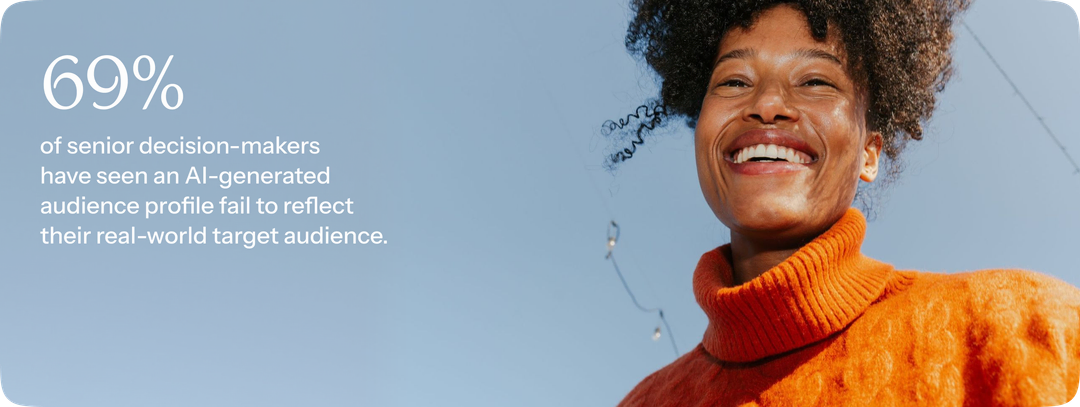
In practice, 69% of survey respondents have seen an AI-generated audience profile fail to reflect their real-world target audience. The most misleading audience profile may be the one that looks familiar. When AI reinforces what an organization already believes about its customers, old assumptions can pass as new insight, while changing needs and emerging audiences go unnoticed. The result is a strategy shaped by an outdated picture of the people it’s meant to reach.
That matters because audiences do not stand still. Behaviors and motivations evolve with time, adjusting to shifting cultural norms or reacting to economic conditions, which AI can miss. For example, GWI’s data shows that women are the new core user base for Reddit’s audience (GWI USA), a shift that most AI tools would be unlikely to capture. GWI’s data comes directly from a representative sample of consumers, measuring what people think, feel, and do. It provides a current view of audiences rather than simply a reflection of what has already been written about them.
Rely on AI alone and you risk inaccurate profiles and missed groups. If women are moving into traditionally male-coded spaces, would a model trained on past text notice?
Takeaway:
A plausible audience isn’t necessarily a real one.
Before committing to an AI-built audience profile, test its assumptions against evidence about real people’s attitudes, behaviors and needs. Build that validation into the briefing process, not as a final check after the strategy has already taken shape.
Insight 03
AI knows the what, not always the why
AI can report what people do and say, but because the motivations behind behavior are often never written down, explaining why still depends on asking people directly.
For all the questions AI can answer in seconds, one remains stubbornly difficult: why do people behave the way they do? Leaders’ views pull in two directions: 84% are confident AI can accurately explain why people behave the way they do, yet 71% agree it can tell you the “what”, but not always the “why”.
That is where some AI models reach a fundamental limit. They learn from what has already been written: what people do and say. But human behavior is often driven by cultural context and motivations that are not explicitly recorded anywhere. Software can store what people have already done and said but only asking real people can explain the “why”. Representative answers from real people, interpreted in context, are what turns data into human intelligence.
And motivations can be small, unexpected, and sometimes bizarre. GWI’s research highlights a consistent pattern where brand preferences can be influenced by something as simple as the brand sharing the name with the consumer’s environment, even if there’s no other connection. Greek consumers prefer Nike (named for a Greek deity), Arizonans favor AriZona Iced Tea (a beverage created in New York), and consumers in the Patagonia region of South America over-index for buying Patagonia products. Nobody offers that as a reason explicitly. It’s the kind of understanding AI can’t guess, and it only comes from asking real people directly, at scale.
Missing the why behind audience nuances is a real gap: 69% agree AI is weak at understanding motivations, attitudes and emotions. The “what” tells you who to reach and where, and the “why” tells you what will resonate once you get there. Better targeting doesn't automatically create more relevant communication. If AI fills gaps in our understanding with plausible explanations rather than evidence, campaigns may reach the right people without connecting with them.
Leaders aren’t asking for less AI. What they want is the speed of AI, with the answers grounded in data from real people. Our research shows 75% believe AI will never solely replace direct consumer research, with 68% saying the same for culturally specific insights. Consideration which may explain why 80% agree understanding motivations still requires human research. In practice, 91% of organizations are already using, or actively building, AI tools that need external data. By market, the share already using them ranges from 40% in Singapore to 65% in the USA.
That points to where research goes next. As AI takes on more of the workload, human context stays vital, but it no longer has to mean solely desk research or a field study. It can arrive as fresh, human audience data inside the AI tools teams already use, feeding the model as fast as the question is asked. So if real people's answers can be that close to hand, does the “why” have to stay the hardest part?
Takeaway:
Knowing what people do isn’t the same as knowing why.
Decide which questions AI can answer from existing information and which need deeper evidence about human motivation. Use AI to accelerate analysis and synthesis, but anchor explanations of attitudes, emotions and cultural context in human intelligence: evidence that traces back to real people and the questions they were asked.
Insight 04
Bad AI decisions are already costing time and money
Bad AI decisions rarely announce themselves, arriving instead as confident answers whose costs show up first as rework and delay, before growing into financial and reputational risk.
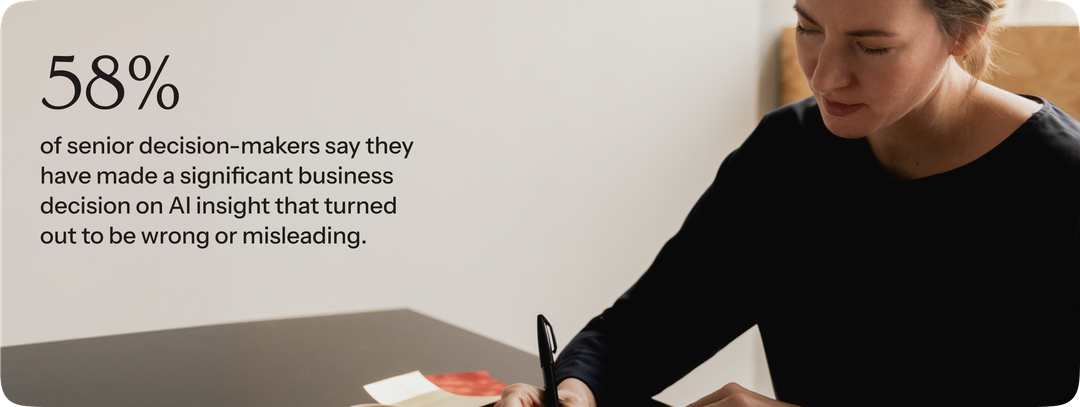
A bad AI decision rarely looks like a disaster when it’s made. It looks like a confident answer: a campaign aimed at the wrong audience, or a plan built on inaccurate numbers, or a decision that seems perfectly reasonable until its assumptions are tested. In our survey, 58% of senior decision-makers say they have made a significant business decision on AI insight that turned out to be wrong or misleading (57% in the USA, 56% in the UK).
The costs show up in everyday work first. 82% have experienced at least one negative impact from inaccurate AI outputs. The most common are internal rework (38%), delayed decisions (36%) and customer complaints (34%), and are easy to overlook as they’re often absorbed into day-to-day operations, rather than recognized as consequences of a flawed insight. Meanwhile, the time saved when an answer is generated can hide the work needed to correct it, so organizations risk counting the efficiency gains while underestimating the cost of errors.
Yet when trust in AI overrides strict checks and efficient guardrails, bigger risks prevail. This can include financial loss (27%), reputational damage (26%), and weaker campaign performance (21%). But the problem isn’t limited to insights. Even courts have been dealing with filings that cite cases that never existed, like a high-profile New York case in 2023.
The commercial impact can be huge. Losses of more than $1M are common in two-thirds of organizations, with 99% of organizations reporting financial losses from AI-related risks, according to EY’s Responsible AI survey.
The risk is no secret: 85% rate the risk of decisions based on inaccurate AI insight as significant, rising to 88% in the USA, but, as stated earlier in this report, knowing the risk hasn't stopped confidence running ahead of it.
As AI is involved in more decision-making, the gap between confidence and certainty matters more. One unchecked answer might cost a round of rework, but across a business, that habit can reveal itself as a strategy that looks like everyone else's and, as some leaders already report, reputational damage. The question stops being whether to use AI and becomes what stands between an AI answer and a trusted decision.
Takeaway:
The more consequential the decision, the stronger the evidence should be.
Set different validation thresholds for different levels of risk. Low-stakes exploration can run with lighter checks; decisions involving substantial investment, customer impact, or reputation need stronger evidence and a named owner. Track errors and their consequences to refine those thresholds over time.
Insight 05
Governance on paper
While most organizations have a formal framework for AI insight, responsibility for AI-informed decisions remains unclear. A framework that no one owns risks becoming a policy to point to, rather than one to act on.
When everyone is involved in an AI decision, it can become unclear who is actually responsible for it. Putting a process between a decision and the person who made it, so that no one ultimately answers for the outcome, is known as an accountability sink. AI didn't create the problem, but it can amplify it.
As AI becomes part of the weekly routine for insight work, an AI answer can play the part of the system itself. It arrives fast and fluently, and it's easy to treat it as the system's decision, rather than anyone else’s responsibility. So where does the buck stop?
What our analysts say:
We expect AI to be given more independence, and we think the pace should be set by evidence rather than enthusiasm. A new analyst takes on bigger work only after the smaller work has been checked, and organizations that treat AI the same way, with clear levels for what it can do alone, are likely to be on firmer ground. The point is not that AI has earned that trust yet, but that there should be a way to find out.
In our survey, leaders haven't settled where responsibility sits. 35% say it's shared, 24% the organization, 21% the AI provider and 19% the employee using the output. No answer has a majority, and the most popular is, by definition, no single owner.
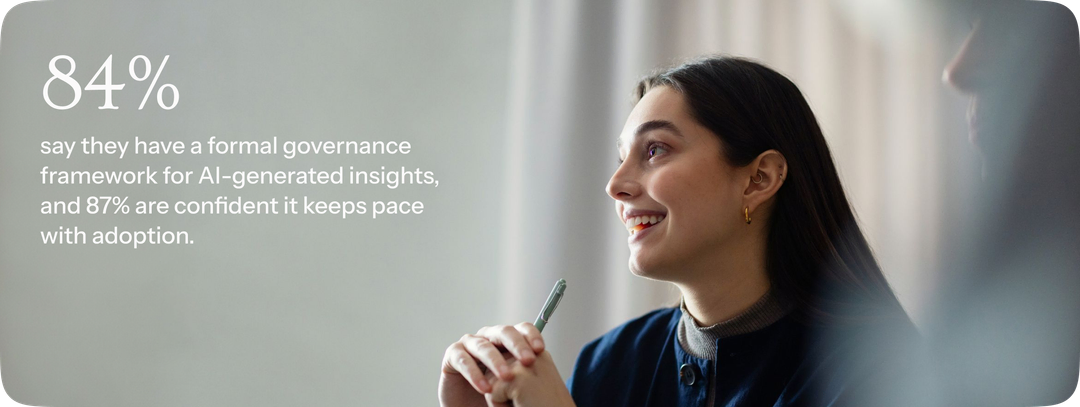
On paper, the guardrails are there. 84% say they have a formal governance framework for AI-generated insights, and 87% are confident it keeps pace with adoption. Yet human validation (48%; 50% in the USA, 46% in the UK) ranks among the most requested safeguards, while only 25% prioritize ensuring that data is methodologically defensible (22% in the USA, 27% in the UK). With 82% having already experienced a tangible negative consequence from inaccurate AI outputs, the gap isn’t necessarily a lack of policy; it’s whether governance translates into practice when decisions are being made.
A framework can set the rules, but it can't take responsibility for the decision. With leaders split on who should be accountable, ownership can become blurred just when it matters most. Effective governance makes responsibility explicit: who signs off, what evidence they need, and when an AI-generated insight requires human review.
Accountability for AI is moving beyond the boardroom. Worldwide searches (Google Trends) for "AI governance" rose alongside searches for the "EU AI Act" and "AI policy", all three stepping up together in August 2025. But when regulation searches fell back from their fall 2025 highs, governance kept climbing, peaking in May 2026. By September, "EU AI Act" searches stood at about a sixth of their peak and "AI policy" at about a third, while "AI governance" stood at about half. Regulation may have put the topic on the agenda, but interest in governance appears to have outlasted the headlines.
82% say they're very or extremely prepared for emerging AI regulation, while 59% are very or extremely concerned it will force significant changes to how they use AI insight. Both point to the same test, whatever the rules end up requiring: when someone asks how AI insight is used and who answers for it, will there be an answer?
Writing a framework is the easy part but it only works if someone maintains it and someone owns it. Without that, the stereotype in a profile and the strategy that looks like everyone else's can still get through, and the framework risks becoming the next accountability sink: a policy to point to that no one acts on.
Takeaway:
A policy only matters when it changes a decision.
For each category of AI-assisted decision, define who is accountable, what evidence is required, when human review is necessary and how outcomes will be monitored. Make those requirements part of everyday workflows, with evidence sources that decision owners can inspect and defend.
Key takeaways
The question behind this report is simple: can leaders trust what AI tells them about people? Our answer is yes, when it's checked and when it's built on the right inputs and human intelligence.
But AI isn't the problem. It is deeply embedded in how businesses work, and for good reason. The catch is knowing what the AI system has been trained on; most models favor the loudest and the most obvious voices from the web, which might be why 75% agree AI reflects patterns found online rather than real consumer opinions.
When it comes to building confident workflows embedded in AI, consider three things:
- Hold AI to the standard you’d set a junior analyst: an answer about people is a lead to verify, not a result to act on.
- Give every output a named owner.
- Feed the model data you can trust: timely, human and representative.
AI will always have an answer. The advantage will belong to those who know what it was built on, when to question it, and when a human answer is the one that matters.
Where to go next
AI can generate the answer. Human intelligence that understands people makes it worth acting on.
New to GWI?
Bring real people into the picture. AI can tell you what’s likely. GWI shows you what people actually think, feel and do, through validated, representative survey data on consumers around the world. Use it to challenge assumptions, sharpen your view of audiences and give AI answers a stronger evidence base.
Explore the human intelligence platform
Already use GWI?
Put human intelligence to work across your AI tools. Bring GWI’s consumer insights into the AI tools your teams already use. With GWI’s agentic products, teams get answers grounded in real consumer data, with supporting evidence, across Claude, ChatGPT, Copilot, Gemini and your own tools. And you decide which audiences and data everyone works from, so answers stay consistent as more people ask.
Explore GWI’s agentic portfolio
Blog
AI is making it dramatically easier for marketers to generate audience insights. But generic AI models can give marketers a polished, inherited version of an audience based on information that is incomplete...
Methodology
This report is based on the GWI study “The Future of Consumer Insight in the Age of AI,” fielded among 1,883 senior marketing, insights, and agency professionals across the UK (n=665), USA (n=850), and Singapore (n=368). All respondents work at companies with 500+ employees or £20m+ annual turnover, in CPG/retail, media/technology, agencies, sports, gaming, or travel, and are decision makers or decision influencers in B2B research purchasing. Fieldwork took place in Q2 2026 [exact fieldwork dates and survey method to be confirmed].
Two respondent groups are used throughout this report to break out findings:
- Decision Makers (n=1,221, 65% of sample): final sign-off authority on approving budgets/expenditure for research and insight purchasing.
- Influencers (n=564, 30%): key influencers/strong input on budget decisions, without final sign-off.
- Other / limited involvement (n=98, 5%): consulted occasionally or not involved in budget decisions. This group is small and figures should be read as directional.
Country cuts (UK / USA / Singapore) are shown wherever differences are meaningful. All percentages are rounded to the nearest whole number and calculated against the valid base for each question; multi-select questions do not sum to 100%.
Full question-by-question results, including every country and segment cut, are available in the companion results file delivered alongside this report.

Get fresh insights weekly
Subscribe today