
Every business decision is a bet. Types of market research exist to help you stack the odds in your favor, giving you evidence where you'd otherwise have instinct, and clarity where you'd otherwise have a conference room full of conflicting opinions.
But here's the thing: not all research is created equal. Each type answers a fundamentally different question, and using the wrong one is a surprisingly common way to waste both time and budget. A brand that needs to understand why customers are leaving doesn't need a quantitative survey. It needs qualitative depth. A team trying to size a new market opportunity doesn't need focus groups. It needs hard numbers.
This guide covers the main types of market research, the methods used to conduct them, and real examples of how they work. We'll also help you figure out which type fits your situation, because collecting data is only useful if it's the right data.
Quick note on terminology: types of market research describe the kind of research you're doing (primary, qualitative, brand research, and so on). Methods describe how you do it (surveys, interviews, focus groups). The two are closely linked, and we'll cover both.
In this guide, we'll cover:
1. What is market research?
2. The main types of market research
3. Primary research
4. Secondary research
5. Qualitative research
6. Quantitative research
7. Exploratory research
8. Consumer research
9. Competitive research
10. Brand research
11. Product research
12. Market segmentation research
13. Market research methods
14. How to choose the right type of market research
15. Market research examples
What is market research?
Market research is the process of gathering and analyzing information about consumers, competitors, and markets to make better business decisions. It overlaps significantly with consumer research, but it's broader in scope, stretching into competitive dynamics, pricing, distribution, and market sizing.
Why does it matter? Because without it, strategy is just opinion. Market research gives you the certainty to commit resources, launch products, enter markets, and defend your plans to stakeholders who want to see evidence, not enthusiasm. The alternative is hoping for the best. And while optimism has its place, it's not a business strategy.
What are the types of market research?
There are several ways to slice this. Some types describe how data gets collected (primary vs. secondary). Others describe the nature of the data itself (qualitative vs. quantitative). And then there are types defined by the specific question you're trying to answer, whether that's about your consumers, your competitors, your brand, or your product.
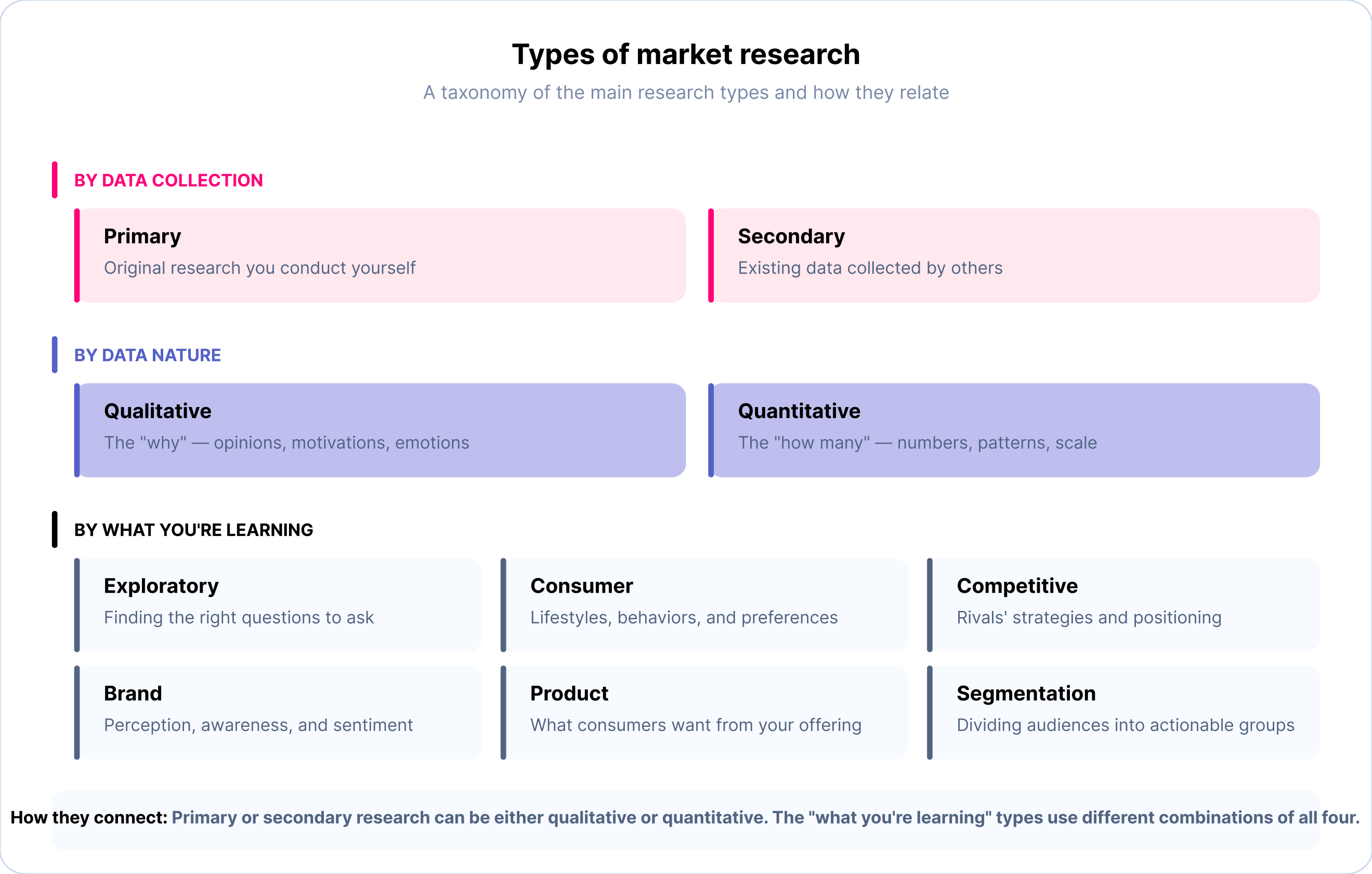
Primary research
When you need answers tailored exactly to your business, primary research is where you go. It's original research you conduct yourself (or commission someone to do on your behalf), going directly to the source to gather firsthand information through surveys, interviews, focus groups, or observational studies.
The advantage is control. You decide the questions, the audience, and the methodology, which means the results speak directly to your objectives. If you need to know how a specific segment feels about a specific product in a specific market, nothing else comes close. That's why primary research remains the gold standard for high-stakes decisions.
The trade-off? Time and cost. Good primary research requires careful design, and if your sample isn't representative, bias can creep in and undermine the whole exercise. But when the decision is big enough to justify the investment, primary research gives you the kind of conclusive, detailed evidence that other types simply can't.
Secondary research
Not every question requires starting from zero. Secondary research draws on data that's already been collected, analyzed, and published, things like industry reports, government statistics, white papers, analyst commentary, and academic studies. You're not generating new data. You're finding value in what already exists.
It's faster, cheaper, and more accessible than primary research, which makes it a natural starting point. Want to understand market size, benchmark against industry averages, or get a read on macroeconomic trends? Secondary research gets you there without the overhead of designing and fielding your own study.
The catch is that none of this data was collected with your specific questions in mind. It might not perfectly match your audience, your geography, or your product category. And because it's publicly available, your competitors have access to the same information. That doesn't make it less valuable, it just means secondary research works best as a foundation. It's the homework you do before the real exam. Use it to sharpen your focus so that when you invest in primary research, every question counts.
Our guide on how to conduct market research walks through how to build on that foundation effectively.

Qualitative research
Numbers can tell you what's happening. They're less helpful at explaining why. That's the gap qualitative research fills.
Through open-ended interviews, focus groups, and in-depth discussions, qualitative research digs into the motivations, emotions, and perceptions that sit behind consumer behavior. Questions like "Why do you prefer this product over the competition?" or "What would make this service worth paying more for?" generate the kind of textured, human insights that a spreadsheet can't capture.
This type of research is at its most powerful when you're in unfamiliar territory. Developing something new? Entering a market you don't fully understand yet? Trying to figure out why a campaign fell flat despite strong targeting? Qualitative research gives you the context. The sample sizes are smaller than quantitative studies, so you won't get statistical generalizability. What you will get is depth, and depth is often what turns a decent strategy into a sharp one.
Quantitative research
Quantitative research is where instinct meets proof. It collects numerical data at scale, typically through structured surveys and questionnaires, to measure trends, identify patterns, and validate hypotheses with statistical confidence.
This is the type of research that answers questions like: what percentage of our audience prefers feature A over feature B? How has brand awareness shifted over the last 12 months? What's the market size for a new product category in three target regions? The answers come in numbers, which makes them measurable, comparable, and defensible, exactly what you need when building a business case or presenting to the board.
GWI's approach is built on this model. Survey data from 960k respondents annually across 50+ markets delivers the kind of breadth and statistical reliability that gives insights teams genuine confidence in their recommendations. And because the data is accessible on demand, the gap between question and answer shrinks from weeks to seconds. That's a meaningful shift for anyone who's ever waited on a third-party study while a decision window closed.
Exploratory research
Sometimes you don't know what you don't know. Exploratory research exists for exactly that situation. It's the type you reach for when the problem isn't clearly defined, the opportunity is vague, or you're stepping into territory where your existing assumptions might not hold up.
Rather than testing a specific hypothesis, exploratory research casts a wide net. In-depth interviews, small focus groups, open-ended analysis of existing data from new angles. The goal isn't conclusive answers. It's better questions. A brand planning to expand into a new region might use exploratory research to surface cultural nuances, unexpected competitor dynamics, or consumer attitudes they hadn't anticipated. That intelligence then shapes everything that follows, from survey design to messaging strategy.
Think of it as reconnaissance. It won't win the battle on its own, but it dramatically increases your chances of fighting the right one.
Consumer research
What do your customers actually care about? Not what you think they care about, not what your last campaign assumed they care about, but what genuinely drives their choices, habits, and loyalty. That's the territory consumer research covers.
It gathers information about people's lifestyles, behaviors, needs, and preferences, usually in relation to a specific product, service, or category. Examples of consumer research in action include building buyer personas that reflect real people, identifying what drives purchase decisions in a category, spotting consumer trends before they become obvious, and creating segments that make your marketing sharper.
This is where consumer research platforms like GWI change the equation. Instead of commissioning a bespoke study and waiting weeks for a deliverable, you can access on-demand insights from real consumers across 50+ markets. Build audiences, test hypotheses, spot patterns, all in real time. It turns research from something you schedule into something you just do.
Competitive Research
You can know your audience inside out and still lose if you don't understand your competition. Competitive research evaluates your rivals' strategies, positioning, market share, and customer perceptions so you can make informed decisions about where to differentiate and where to compete head-on.
It typically draws from a mix of sources. On the secondary side: published financials, industry reports, competitor websites, and public marketing materials. On the primary side: consumer surveys that measure brand perception, consideration, and preference across you and your competitors. Together, these paint a picture of what your rivals are getting right, where they're vulnerable, and where the white space sits.
The mistake many brands make is treating competitive research as a one-off exercise, something you do before a launch and then file away. The brands that get the most out of it treat it as ongoing intelligence, a way to spot shifts early and respond before they become problems.
Product research
A brilliant product that nobody wants is just an expensive hobby. Product research exists to prevent that outcome, giving new launches their best chance of success and helping existing products improve or grow share.
It's one of the most commercially direct types of market research because it connects insights straight to what you're selling. Qualitative approaches (concept testing, user interviews, prototype feedback) help you understand what people think, feel, and wish for. Quantitative approaches (surveys, conjoint analysis) tell you which features matter most, what people will pay, and how they'd choose between competing options.
Here's where it gets practical. Say you're a tech company developing a new wearable. Product research might reveal that your target audience ranks battery life and comfort well above the advanced health tracking features your engineering team is most excited about. That's the kind of finding that redirects months of development effort and potentially saves the entire launch from underperformance.
Brand research
How people perceive your brand is either an asset or a liability. Brand research helps you figure out which one, and what to do about it.
It covers the full spectrum: awareness, consideration, sentiment, loyalty, and advocacy. Do people know you exist? When they think of your category, do they think of you? What words and associations come to mind? How do you stack up against competitors in the minds of your target audience? These aren't abstract questions. The answers directly shape messaging strategy, campaign planning, and long-term brand building.
Where brand research really proves its worth is in tracking over time. A single snapshot tells you where you stand today. Regular tracking shows you how perception is shifting, whether a campaign actually moved the needle, and where to course-correct before a small problem becomes a big one.
Market segmentation research
"Everyone" is not a target audience. Market segmentation research divides a broad market into distinct subgroups based on shared characteristics, whether that's demographics, behaviors, attitudes, values, or needs, so you can focus your efforts on the people most likely to convert.
The applications are immediate and practical. Segmentation drives targeted marketing, personalized messaging, efficient media spend, smarter product development, and more confident market expansion decisions. It's the difference between speaking to a crowd and having a conversation with the right person.
GWI makes this type of research significantly more accessible. With 50k+ profiling points across 50+ markets, you can build, profile, and size audience segments based on everything from media consumption and purchase behavior to attitudes and lifestyle preferences, without the lead time and cost of commissioning custom segmentation studies.
Market research methods
So those are the types. Now for the methods, the practical tools you use to actually gather insights.
Surveys and questionnaires remain the workhorse of quantitative research. They scale well, adapt to almost any topic, and can be distributed online, by phone, or in person. For measuring attitudes, preferences, and behaviors across large groups, nothing beats them for efficiency.
Interviews go deeper. Whether face-to-face, by phone, or over video, they allow researchers to follow up, probe, and explore responses in real time. The depth of insight is significantly richer than a survey, but the trade-off is sample size and time investment.
Focus groups bring small groups together for guided discussion, and they're particularly effective for testing reactions to new concepts, creative work, or messaging. The group dynamic can spark perspectives that one-on-one conversations miss, though skilled moderation is essential to keep the conversation honest rather than performative.
Consumer research platforms take a different approach entirely. Rather than designing a study from scratch, platforms like GWI give you access to a continuously updated data set built on survey responses from real people across 50+ markets. The speed advantage is substantial: questions that would take weeks to answer through traditional research get answered in seconds. And for questions that need truly bespoke investigation, custom research lets you ask anything you like, tailored to your exact needs.
Social listening captures what people are saying on social media, forums, and public channels. It's valuable for surfacing trends and tracking unfiltered sentiment, but it comes with a reliability caveat. What people post online and what they actually do aren't always the same thing. As anyone who's ever tweeted about going to the gym knows.
Public domain data from government agencies, research centers, and think tanks provides a free, often rich, foundation for secondary research. It may not be perfectly current or specific to your niche, but it's an efficient way to build baseline understanding.
AI-powered research tools are reshaping the landscape. Tools like GWI's Agent Spark let you query large consumer data sets using natural language, which means deep insights are accessible to people who aren't data analysts. Critically, Agent Spark is powered by real survey data from real people, not web scraping or synthetic outputs. The quality of the insight is only ever as good as the data behind it, and this is where methodology matters.
For a full breakdown of when and how to use each method, our guide to market research methods goes into more detail.
How to choose the right type of market research
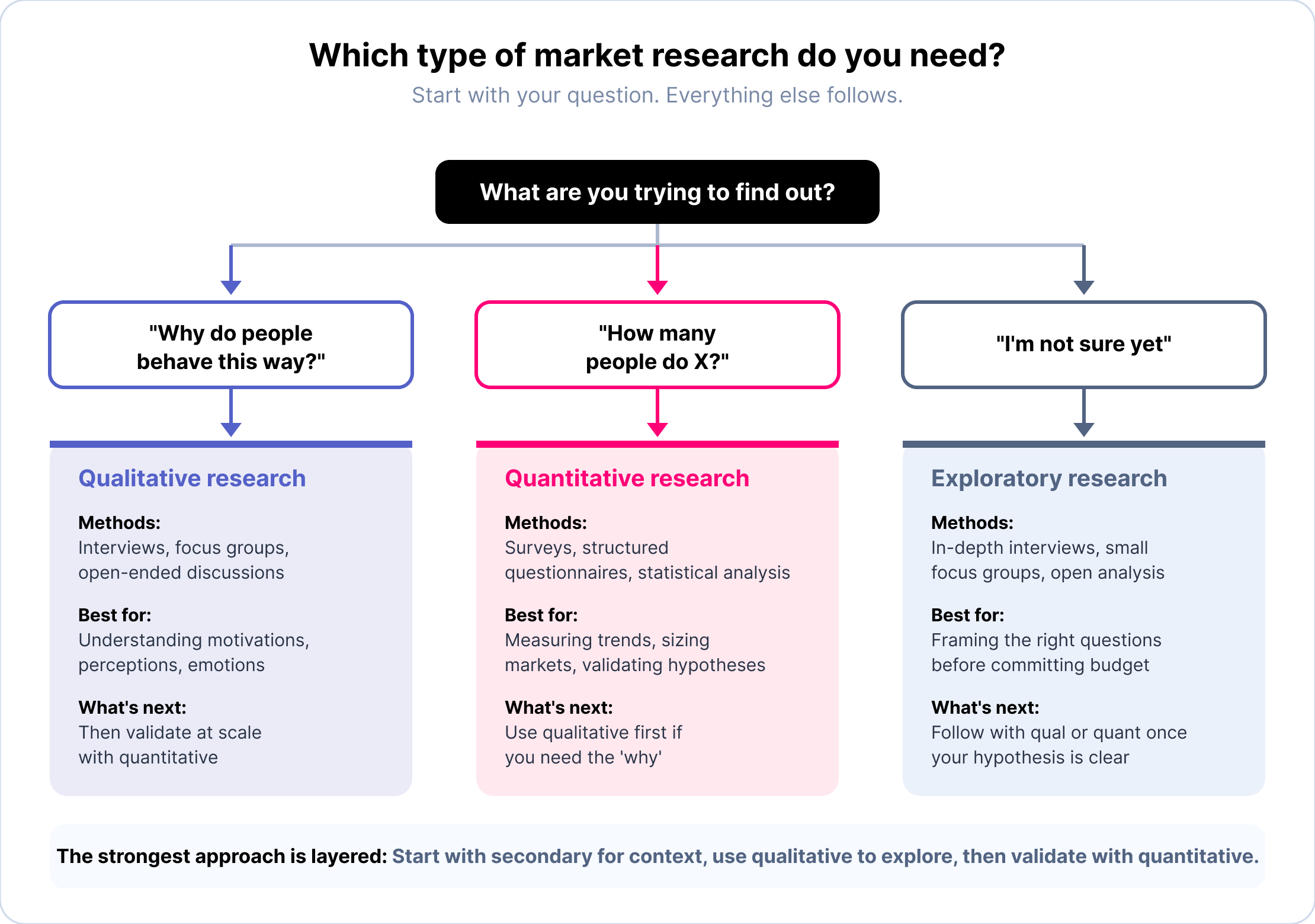
The decision starts with your question. Every other consideration follows from there.
If your question is "why," you need qualitative research. Why are customers leaving? Why did this campaign resonate in one market but not another? Why do people associate our brand with X instead of Y? Interviews and focus groups will surface the motivations and emotions that sit behind the data.
If your question is "how many" or "how much," you need quantitative. How large is the addressable market? How many consumers prefer our product over the alternative? How has satisfaction changed since last quarter? Structured surveys and large-sample data give you the statistical confidence to answer these decisively.
And if you're honest enough to admit you don't quite know what the question is yet, start with exploratory research. It's designed for exactly that situation, helping you find the right direction before you invest in a full-scale study.
Beyond the research question, practical constraints matter. Budget tight? Secondary research and consumer research platforms give you meaningful insights without the overhead of bespoke primary studies. Working to a deadline? On-demand platforms compress the timeline from weeks to minutes. Need to convince skeptical stakeholders? Quantitative data with large sample sizes and clear statistical backing is your strongest card.
The smartest approach is almost always layered. Start with secondary research to map the landscape. Use qualitative to explore the nuances and test your assumptions. Then validate at scale with quantitative. Each stage informs the next, and by the time you're making the decision, it's built on something solid rather than a single study done in isolation.
Market research examples
Independent agency Bright/Shift used GWI consumer insights to build a go-to-market strategy for a sustainable furniture client. By combining audience profiling with behavioral data, they pinpointed the right target segments, developed messaging that landed, and generated £41K in revenue in the first month. Here's how they did it.
For a different angle, Australian agency BCM Group used GWI to help Queensland University of Technology develop a new executive leadership program. Through custom research and segmentation, the team identified three distinct professional segments making up 88% of their target market, then benchmarked against competitors to optimize positioning. The result was a product shaped around clearly identified audience needs rather than assumptions. As BCM's Director of Media and Engagement put it, GWI gave them "the level of detail we needed to shift our client's way of thinking at a fundamental level."
These two examples show what layered research looks like in practice. Bright/Shift leaned on consumer research and audience profiling to nail a go-to-market strategy. BCM combined segmentation, competitive research, and product research to build something from the ground up. Different industries, different objectives, same principle: the strongest outcomes come from combining multiple types of market research rather than relying on any single one.
Fancy a look around?





.webp?width=495&height=317&name=pink_thumb_graphs%20(1).webp)
.webp?width=495&height=317&name=pink_thumb_letter%20(2).webp)